

Thursday, May 31, 2012
A Thousand Faces
Lon Chaney
The Man of A Thousand Faces
More than 80 years since his last film, the name Lon Chaney still conjures up powerful images of the macabre even among fans who have never seen one of his films. Best known for his defining performances of Quasimodo in 1923’s Hunchback of Notre Dame and as Eric in the Phantom Of The Opera (1925), Chaney set a standard for film acting that has been approached, but never exceeded.
 Chaney was born Leonidas Frank Chaney on April 1, 1883 and passed away at the age of 47 in 1930. Along the way he became one of the biggest stars of his era and the first actor to employ a more naturalistic (re: modern) style of film acting. He was the Bogart of his era.
Both of Lon’s parents were deaf and mute. In order to communicate with his parents, Lon became skilled at the art of pantomime, a skill that would serve him well in the coming art form of Silent Film.
Although remembered as a “horror” actor, Chaney was more of a character actor and his portrayals covered a huge range of subjects from classics such as Hunchback, to modern crime dramas like The Penalty (1920) and While the City Sleeps (1928). Even films like Phantom Of the Opera and Hunchback were not, strictly speaking “horror” films.
In fact Chaney created characterizations that are still the template for their modern counterparts. His portrayal of 'Dan' Coghlan, the world weary and tough as nails detective in While The City Sleeps set the stage for Bogart’s Sam Spade through Telly Savalas’ Kojak. His turn as the demented crime lord “Blizzard” in the Penalty inspired every gangster protrayal from Edward G. Robinson in Little Cesar right up to Pachino’s Scarface.
Tell It to the Marines is a 1926 movie starring Lon Chaney and directed by George W. Hill. The film follows a Marine recruit and the sergeant who trains him. It was the biggest box office success of Chaney's career and the second biggest moneymaker of 1926/1927. In this film Chaney plays the rough marine “Sarge” with a heart of gold. His turn as “Skeet” burns can be found in nearly every war film to come out of Hollywood in the last 85 years. This film was a special favorite of Chaney’s because of his love of the Marine Corps. In fact, his portrayal struck such a chord within the Corps, he would become the FIRST actor ever to be made an honorary Marine. A reviewer in Leatherneck Magazine wrote that "few of us who observed Chaney's portrayal of his role were not carried away to the memory of some sergeant we had known whose behavior matched that of the actor in every minute detail ...
Such was the impact of Chaney the actor.
In the area of the macabre, it was his pairing with legendary director Todd (Dracula) Browning that cemented Chaney’s reputation as a genre star. Lon did 10 films with browning including “The Unholy Three” and as Alonzo the armless knife thrower in “The Unknown” . Chaney did not so much play monsters as tragic, often deformed men outside of normal society. His portrayal of Pharso “dead legs” in the 1928 silent “West Of Zanzibar” is a perfect example of this “man as monster” portrayal. In the film Chaney is a cuckolded husband whose wife cannot tell him of her affair. Instead his wife’s lover, informs Phroso that he is taking Anna to Africa, shoving the distraught husband away so forcefully that he falls over a railing and is crippled, losing the use of his legs. After a year, Phroso learns that Anna has returned. He finds his wife dead in a church, with a baby beside her. He swears to avenge himself on both Crane and the child. Eighteen years later, Pharso has taken the child to a hellhole in Zanzabar where he makes her daily life a never ending torment. It is only when he chances upon his wife’s former lover that Chaney learns that the child is actually HIS daughter. Chaney’s reaction to the horror of what he himself has become is one of the most chilling moments in film history and a perfect example of Chaney the “horror” actor.
Lon’s reputation as a horror actor was actually cemented by the late Forrest J. Ackerman who was the founder and editor of Famous Monsters Of Filmland Magazine which began publication in 1958. At that time silent films had largely disappeared from public view. And the generation of silent stars were mostly forgotten except by those who actually saw them. Ackerman had, like millions of other filmgoers, been deeply moved by Lon’s portrayals in Hunchback and Phantom . he published on a regular basis photos and articles about the great silent film star. He especially played on “the Man of A Thousand Faces” aspect of Chaney’s work, building a legend around the star among generations of fans who never saw his work. In fact, it was through FMF that I became fascinated with the life and work of Lon Chaney.
My first exposure to Chaney came in a barely viewable, heavily edited, print of Phantom of the Opera that was aired on “The Joe Franklin Show” on WOR (Channel 9) back in the late 1960’s. Franklin had a long running TV and radio shows in the area that focused heavily on nostalgia and silent film. In fact it was just about the only venue outside of an art house where one could see any silent film. Even heavily edited and projected on modern equipment which under cranked the film, making it run at 24fps as opposed to the intended 18fps, the power of Chaney’s performance was undeniable. I was hooked.
Of course in those days most of my exposure to Lon was only through Forry’s magazine and some grainy footage. There simply was not a lot of access to this locked off period of early cinema. Happily the advent of film preservation societies, DVD and digital video and TCM (Turner Classic Movies) has opened up a huge library of early film that has been remastered and can now be seen as originally intended. This includes a large cross section of Lon’s work. Today fans can see Phantom of the Opera as it was originally shot, including scenes that were filmed in an early two strip technicolor! Tell it To The Marines is available as are films like The Unknown, The Unholy Three, West Of Zanzibar and many more Chaney classics. Even the “lost” London After Midnight has been restored, after a fashion under the auspices of Turner Classic Movies.
Chaney often said that “between pictures there IS no Lon Chaney”. Nothing could have been further from the truth. In his private life, Lon was a devoted husband and father. He was an avid sportsman who loved hunting and fishing. He was a wonderful dancer and loved to tinker with home movies. Lon was an all around average Joe! He also raised a son, Creighton, who would become known to the world as Lon Chaney Jr. and a film legend in his own right as The Wolfman.
Lon was also a strong advocate for the men and women behind the scenes, always pushing for better pay and better hours for the cameramen, grips, and support crew that were so integral to his cinematic creations. Some years before another actor would find his own fame, Chaney gave some advice to a struggling young man who would become the great Karloff. He told him to find one thing he did better than anybody and stick to it. Obviously Karloff took that advice to heart.
Lon passed away at the too young age of 47 from bronchial lung cancer in 1930. He left behind a rich legacy of film, many original characterizations that have become templates for actors to this very day, and a mystique. The mystique of “The Man Of A Thousand Faces”. Film lovers today are very lucky that they have the opportunity to experience that legacy first hand. For those of you who are going to see your very first Lon Chaney film, I envy you.
Sit back, watch, and wonder.
Lon Chaney…a thousand faces
That’s 30!
Mitch

Thursday, May 17, 2012
Finding Light In The Dark Age Of Comics
I thought I would ask the SECOND biggest comic geek I know to do a guest column this week. I am talking about none other than my own daughter Alyx who many of you call Sasha. I was going to say something pithy but I will just let her work speak for itself. I may be biased but i think it's good stuff!
The world isgetting a little to dark and gritty for me. Not Liefeld gritty but definitely Millergritty. I won’t insult your intelligence by stating the obvious too often buthang on don’t stop reading I’m building up to something when I say that we livein a genuinely pessimistic age and our pop-culture is very reflective of that.
. The end of the SilverAge showed that characters COULD die now and the Bronze Age took a darker bendto it as well, but never without plot relevant reasons. The Bronze Age endedwhen Watchmen and Dark Knight Returns hit the shelves and changedeverything. Art got darker, the plot lines got darker, and heroes were morelikely to be anti-heroes and sometimes downright unlikable (in the case ofUltimate Wolverine). This also became the height of Rob Liefeld’s career andwhile he certainly can’t draw his age left many new characters who are massivefan favorites today…after someone else started writing them, as was the casewith the ever lovable Deadpool.
For most people myage who lack the education my father so kindly bestowed upon me (hey, someonehas to take up the shield) the idea of comics brings really only three thingsto mind: Batman, non-Euclidian body shapes, and convoluted stories. Eventalking to some of my friends who don’t read comics with the same enthusiasm Ido can be a challenge because when trying to explain that Thor’s Uru hammer Mjolniris a cane in that panel and no really this Donald Blake guy is totally Thor butisn’t really a secret identity but is a separate person and wait where are yougoing? Even trying to talk about Cable is impossible as you can imagine. Convincingpeople to pick up a comic these days becomes a pain when they’re under theimpression that either the stories are completely ridiculous or impossiblydark.
For about twodecades it’s been hard to pick up an ongoing comic and not find a senselessdeath (A la Speedy’s daughter Lian in Cry for Justice), a flanderizedcharacter (Ultimate Captain America sticks out most in my mind), or heroesdoing stupidly, strangely evil and nonsensical things with no foreshadowing orgoing directly against previous canon (Maxwell Lord). The anti-hero characters thatget darker often become nigh unlikable, again in the case of the already dark Wolverine’sincarnation into the Ultimate universe. In Ultimates 3, he responds toHawkeye's comments that he used to be in the brotherhood with the comment"Yeah, and you used to be married with two kids"; a reference to hisfamily's murder in the previous story.
I’m not sayingthat all dark, gritty, violent stories are bad and I have nothing against agood spot of the old ultra-violence. In fact, many of them are quite good,particularly Dennis O’Neil’s 1987 run on The Question which I hold to bethe greatest incarnations of the character and one of my favorite noir stylecomics, though I may be biased as he is my favorite superhero. What I am sayingis that in a lot of stories, these conventions tend to be a crutch for thewriter and the narrative arcs become bland only broken up by blood spatters onthe page.
You don’t need tobuild up good suspense when you can have a wham death or startling gore on the smearingits way across panels. The issue isn’t violence; it is the lack of effectivelyused of violence within many stories in this day and age. When Gwen Stacy diedit was tragic and changed the face of comics forever, when Jason Todd died itwas shocking and changed Batman forever, and even when The Question died fromlung cancer in 52 it resonated with the reader. When Marvin gets killedby Wonder Dog in Teen Titans #66 or when the Wasp was cannibalized bythe Blob in Ultimates 3 it’s just shock horror with no lead up and noreal emotion attached. They stop being people and start being cannon fodder andas anyone who knows Star Trek well can tell you, you never get attachedto the red shirts.
What makes thiseven sadder is that bright, genuinely well written comics like the pre-new 52 BlueBeetle run don’t last as long as they should have because the writers foundbetter ways to inject their stories with life and had a use for any violenceand gore they decided to use. The stories with a lighthearted bend are seen asbeing “kid’s stuff” and aren’t as well appreciated by older readers because ofthis.
So the title ofthis article is about finding the light. What do I mean by that? Well it’spretty simple. Some heroes just plain refuse to be dragged down to this leveland I feel like they should be commended. For every story where someone isholding the idiot ball and is acting like a villain, there’s a Captain America(main continuity Cap) to plant himself like a tree beside the river of truthand refuse to move. For every morally questionable action Batman commits thatchips away at his three-dimensionality, there’s a Superman to talk a person downfrom suicide. And for every attempt to shoot the Hulk into space, there’s afriendly neighborhood Spider-man looking into the abyss and not blinking.
There arearguments that Captain America and Superman are boring characters and a lot ofthat comes from this stubbornness to keep from becoming gritty. Superman isoften accused of not being three dimensional and Cap suffers from being seen asirrelevant to most casual comic fans who’d rather read about anyone else. Theyare examples of a bygone age where a city could be in a bottle and you couldsock Adolf Hitler in the jaw and no one would scoff but they are stillrelevant. One of the biggest things the writers of these dark, gritty storiesoften forget is that there needs to be hope. Light at the end of the darkMiller-esque tunnel. When a story is oppressively dark and violent, when no onecan come in and save the day or at least offer a helping hand, the story itselfloses three dimensionality and becomes boring.
So what has beenthe point of my rambling? Simple. Give the lighthearted stories a chance anddon’t immediately assume that the dark stories are more complex and byextension better. Don’t be afraid to believe in Superman or Captain America.And be discerning, a good, dark story should make you feel something but shouldn’tbe oppressive and emotionally draining and a good lighthearted story should beuplifting but have the right amount of conflict.
I recommendpicking up the paperback collections of The Question written by Dennis O’Nealand the Blue Beetle collections pre-reboot. They give a great spectrum. Andin the words of Batman about our big blue boy scout: “Flying out of the sky, heonce again shows us why he sets the standard for so many. Many see him as anaive boy scout whipped by his own selflessness. They will not, cannot, see himfor what he is, a hero.”
Forever Knight
Has anybody noticed the de-fanging of the American (or even NON American) Vampire? With shows, books and movies like Tru Blood, Vampire Diaries and Twilight, it seems the Vampire in the post Buffy/Angel era is more concerned with the soap opera state of their relationships with teenaged girls than they are with taking a bite out of humans.
And Now Dark Shadows…DARK FREAKIN’SHADOWS is a COMEDY!!!
STOP the madness!
News flash….Vampires are NOT supposed to be all cuddly! …Monsters much???
Even Angel was good for the occasional homicidal rampage when his soul would go missing. Spike was good for a brawl even AFTER he got his soul back. Hell, even Angel knock off Mick St. John from Moonlight spent as much time throwing down as he did romancing the admittedly ravishing Sophia Miles (of Underworld fame).
Now anyone who even remotely knows me, understands that I still mourn the passing of both my beloved Buffy and (in a manly way of course) beloved Angel. Both shows were able to make vampires compelling and even sympathetic without ever letting the audience forget that these creatures are inherently dangerous. Anne Rice gave us a plethora of Vampires who could out brood Angel himself BUT would regularly take time out from self reflection to rip out a neck or two. I grant you that Angel AND Spike were both obsessed with young Buffy Summers, but SHE could totally kick their asses!
I realize that True blood in particular is very popular but the Vamps there seem as much obsessed by sex and drugs as by BLOOD. Which for most of them is synthetic!!!! What is THAT all about?? Faux Blood is like taking your sister to the Prom!
Where is the carnage?
Where is the murder??
Where is the mayhem???
Where is the FUN??!!!
If not for Walking Dead we’d be surrounded by cuddly, angst ridden monsters! At least you can still count on Zombies.
Ok…enough moaning on my part. Let’s talk about a TV series that may be before your time or have escaped your notice. It was part of the “Crime Time After PrimeTime” late night line up on CBS during the 1992-1996 seasons. It was about an 800 year old vampire turned Homicide Cop struggling, and eventually FAILING in his quest for redemption.
I am talking about Forever Knight.
The adventures of Nick Knight, an 800 year old Vampire struggling to find a place in the modern world was the grand daddy of Vampire TV Shows. The concept was borrowed from the Tomb Of Dracula Character, Hannibal King, created by Marv Wolfman and Gene Colan some years earlier. (King was a private investigator rather than a Homicide Cop and he never actually drank HUMAN blood but he WAS also seeking redemption).
FK was essentially TWO shows in one. The main plot thread would deal with the murder of the week, with a sub plot in flashback to one of nick’s previous “lives” spanning the eight centuries of his existence. These flash backs found Nick interacting with the likes of Joan Of Arc and Hitler. There are essentially two conflicts that cover the life of the series.
Firs t is Nick’s struggle to regain his humanity and his evolving relationship with Natalie Lambert, the coroner who aids him in his cases. Unlike the defanged Vampires of more recent shows, Forever Knight never lets us forget that Nick is inherently dangerous and that he is perhaps MOST dangerous to the humans he cares for. Nick desperately wants to regain his humanity but is always struggling against his Vampiric nature. Because of this he keeps Natalie at arm’s length for as long as he can. Also unlike more modern Vampire Boy meets Human Girl stories, when Nick consummates his relationship with Natalie, he kills her. Nick’s story is ultimately a tragic one ending with him begging his sire, Lacroix, to end his existence. The final shot of the series is Nick on his knees, his back towards Lacroix with his Sire about to plunge a stake into his own “son”.
The other on going conflict in the series is between Nick and his Vampire family. Lacroix and Jannette (his paramour for centuries) simply do not understand why Nick would want to abandon his Vampire nature, and by extension, them. Through the series flashbacks we see that the three spent centuries together and that it was only within the last hundred years or so that Nick set out on his quest for humanity. We see many times where Lacroix foils Nick’s plans. He considers Nick and Janette his children and will not suffer losing either of them. When Nick first comes across Lacroix in modern times, he believes he has killed his sire in a fight. Later Lacroix resurfaces to become Nick’s sometime ally. As for Janette, she now owns a night club for vampires and begins to rekindle her own relationship with Nick. While she does not understand his desire to become human, Janette does not actively try to stop him. In a delicious bit of irony it is Janette who becomes human through her love affair with a mortal. What Nick could never achieve no matter how hard he tried, came to his lover by accident.
Through the length of the series, Nick begins to lose those humans who kept him tethered to the mortal world. Both of his partners (Schanke and Tracy) are killed. And when Natalie dies by his own hand, Nick sees the futility in his quest, realizing he was damned the first time he took an innocent life. His only chance for peace now lies in oblivion.
What makes Forever Knight so special is the fact that the good guys ultimately lose. We spend three seasons rooting for Nick, who is essentially a good, though tortured person only to see him fail. He fails not only himself, but those he cares most for. In many ways this show is far more “adult” than any Vampire series that has come along in all the years after. Geraint Wyn Davies as Nick and Nigel Bennett as Lacroix are wonderful in their roles and perhaps the most believable Vampires ever put on film. They are individuals who are ALSO Vampires, not the other way around. They also understand the consequences of their actions. Even Lacroix is not merely evil but a multi layered personality who is, in fact capable of remarkable loyalty and love for his “children”. Bennett’s portrayal shows us a cynical man who has simply seen too much of the human condition over HIS 1500 year existence to ever embrace Nick’s idealism. Nonetheless he proves to be Nick’s best friend when the chips are down.
FK is also a remarkably SEXY show. It does not get nearly as graphic as Tru Blood or even Buffy. It’s sexuality is suggested rather than depicted, leaving the viewer to fill in the blanks. This technique is always sexier than merely showing semi naked bodies. In Forever Knight the act of feeding is a deeply sexual act and the actors all convey this very strongly.
While not widely viewed, Forever Knight has influenced every Vampire series that has followed. The best of them (Buffy and Angel) manage to actually expand on some of the themes of heroism and loss extant in FK. Angel and Spike are never QUITE defanged. The others are merely shadows of a great concept.
Forever Knight is currently available (all three seasons) on DVD and I recommend it highly for any fan of Vampire fiction or just good TV.
That’s 30!
Mitch
Thursday, April 26, 2012
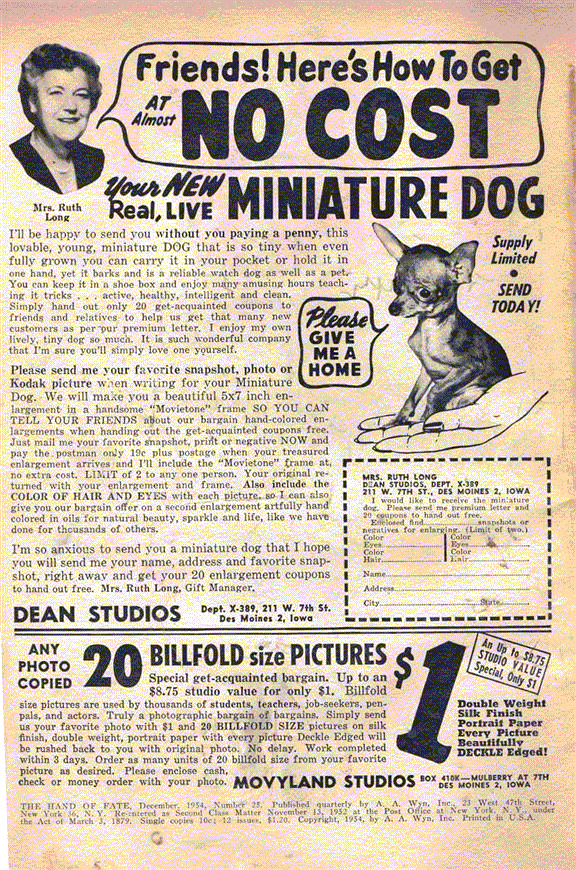
Back in the early days of comic book publishing one of the reasons the books were printed at all was to aid in securing bulk mailing rights for items that could not normally go through the mail and to sell novelties. If you collected comics back in the 1960’s or earlier you would be offered 1,000,000,000 toy soldiers for only $1.99!!
Or SEA MONKEYS…whatever they were. You could buy X-Ray Specs or sell SHOES. You could avoid being a 98 pound weakling who was always getting sand kicked in his face.
The variety was endless. Looking back on it these advertisements are pretty funny. But in the days of Yore (or even mine), comic ads were big business.
Here are some of my favorites from the 1940’s and 1950’s
 Because western heroes never left the prairie without their trusty flashlights.
 “Johnny put your hand grenade away and do your homework.” …yeah…that’ll work.
 This is severely creepy!
 Hey kids! Find Uranium! Irradiate your friends! Raise cancer rates for the whole family!!!
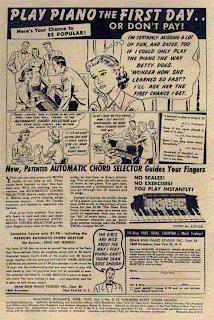 Because guys really love gals who can tickle their ivories! (did I say that?)
And how’s THIS for political correctness?
 “Fat folks”? really….REALLY??!!
You can’t make this stuff up.
That’s 30!
Mitch




Thursday, April 19, 2012
Does Crime Pay?
In 1942 a new comic called Crime Does Not Pay book hit the stands. It was created Charles Biro and Bob Wood. Crime Does Not Pay was the first 'true crime comic book published. By the end of the Second World War this book would boast monthly sales of 800,000 copies. Just as this book was peaking the popularity of the Superhero in Post War America was on the wane. This opened up an opportunity for a new genre to vie for domination of comic book sales for the next decade. Crime Comics.
With sales of Crime Does Not Pay increasing other publishers sought to gain a piece of the market and soon they were launching their own titles. This competition led to an increase in violence and gore, as they each tried to grab the public's attention.

Crime Based comics of the time (1942-1954) in the pre Comics Code days were often graphically violent and, even though the criminals eventually were caught, glorified crime. The books were also meant to titillate the young male audience that read them through the generous use of Good Girl Art (also referred to as GGA or “headlights”).

Eventually, these titles became the target groups that claimed comic books contributed to the rise of juvenile delinquency and illiteracy. After the publication of Dr. Fredric Wertham's Seduction of the Innocent and investigations by the Senate Subcommittee on Juvenile Delinquency, the industry adopted a strict code administered by the Comics Code Authority.
Among other things a Comics Code approved book could not use words like “Crime” , “Horror” or “terror”. In addition Good Girl Art was strongly toned down, vampires, ghouls , werewolves etc. Could not be used and violence was sanitized across the board. In short Crime Comics were effectively “castrated”.
EC Comics, publisher of (among other titles) Crime SuspenStories was particularly hard hit by the new governing body and after a brief foray into less controversial genres went belly up.

Crime comics from this period remain highly collectible items and often fetch high prices in upper grades.
Today Crime Comics have made something of a comeback with titles such as “100 Bullets”, Brubaker’s “Criminal”, “Road To Perdition” and even “Gotham Central”. Proving that while crime may NOT pay, it is certainly profitable in the comic book business!
That’s 30!
Mitch
Thursday, April 12, 2012
Fiction House
When one looks back on the Golden Age Of Comics , generally considered to have been from 1938 (Action #1) and ending with Showcase #4 (1956), it is easy to think of the big three publishers DC, Timely and Fawcett. To be sure those companies DID dominate the early days of what we would come to recognize as the modern comic books. Superman, Batman, Captain America and Captain Marvel among others are all enduring characters who began during the Golden Age and were published by “The Big Three”
However it would be less than accurate to think of “The Big Three” as the only successful publishers of the era. MLJ would be a major factor with Pep, which began as a Superhero title and would later feature a new character named Archie Andrews. EC comics would dominate the latter part of the Golden Age with more adult fare like “Weird Fantasy” and “Tales from the Crypt”. In fact there was a litany of publishers. Quality, Sun, Better Publications, Harvey, Kosmos and Nita just to name a few.
Comics were everywhere. Superman and Captain Marvel regularly sold well over a million copies per month! Today if a comic book title tops 150,000 copies sold in a month it is at the very top of the charts.
Why? Because during the Golden Age comics were sold in literally TENS of Thousands of locations. Every little candy store and news stand in the country (and many international) had a comic book rack. Today comics are largely sold in a couple of thousand comic specialty shops and over the internet. During the Second World War almost 40% of all printed material shipped to the military was COMIC BOOKS. It was a period of popularity in the hobby that has never again been approached. It was a BOOM.
DC, Timely and Fawcett along with the 45-50 other publishers of the time would produce nearly 700 titles during the Golden Age.
And there was Fiction House.
Fiction House was a Comic Book publisher that began life in the 1920,s with a line of Pulp Magazines. Their early publications focused primarily on Aviation and Sports. Fight Stories was a particularly popular title during the 1920’s and focused primarily on boxing. Over time Fiction expanded their pulp line into other genres such as Westerns, Romance, Detective and Science Fiction. The covers often featured GGA (Good Girl Art) with leggy scantily clad females often having nothing to do with the stories therein.
By the late 30’s the Pulp market was starting to decline due to the rising popularity of the infant comic book industry in the wake of such characters as Superman and Batman. Fiction House made the decision to add a line of comic books to their offerings and released Jumbo Comics #1 in September of 1938. Jumbo Comics was not an in house creation. In fact the company purchased it whole from Eisner & Eiger. They were “packagers” of comic books and would sell fully finished product to publishers looking to enter the comic book field.

Jumbo Comics would feature the character that would become the centerpiece of Fiction House, Sheena Queen Of The Jungle. Sheena was created by Will Eisner of Spirit Fame and S.M. Iger. She would go on to become the very first female character to carry her own title, preceding Wonder Woman by several months. Sheena would also embody a central feature of Fiction House offerings….Good Girl Art. Good girl art does not refer to the character of the girl. In fact often the girls were NOT so good. Good Girl Art (GGA) is an artistic pinup style that features beautiful, often leggy women clothed in as little as possible.

However, Fiction House did not usually feature these women as “damsels in distress’. On the contrary Fiction House heroines were tough as nails, guns a blazing CAPABLE women who did not need the men to save them. Considering the time and the way women were generally used by other publishers, Fiction House was remarkable far sighted.
Fiction House had several big selling titles that they called their “Big 6”. They were Jumbo Comics, Wings Comics, Planet Comics, Fight Comics, Jungle Comics and Rangers Comics.

In addition F.H. had a wide range of secondary titles. Among these were Firehair, Ghost, Man O’Mars and Ka’a’nga Jungle King.
Fiction House was remarkable in another area. Their practice of non discrimination. In a era when comic books and business in general was all boys and all white, F.H. employed men of color and women. Matt baker, or maybe I should say (THE GREAT Matt Baker) who is best remembered for his iconic Phantom Lady (Fox Pub.) was a featured cover artist . Baker, who passed away from a heart attack at the young age of 39 was inducted into the Comic Artist’s Hall Of Fame in 2009.

In addition female artists such as Ruth Atkinson, Fran Hopper, Lily Renee and Marcia Snyder were major contributors in the Fiction House Bullpen.
Fiction House would ultimately fall victim to a shrinking post war comic book market and the attacks of Frederick Wertham (Seduction Of The Innocent) who castigated the company for it’s depiction of sexy females. Their last titles would be distributed sometime late 1954 or early 1955 and the company quietly went out of business.
Today Fiction House titles in high grades, particularly Planet Comics, are particularly sought after by comic collectors. Sheena Queen Of The Jungle is an enduring character still seen today .
The legacy of Fiction House as a producer of high quality comic books endures.
That’s 30!
Mitch
Wednesday, April 4, 2012
Batman Odyssey....Yes Virginia, it's ISHTAR Bad!
Have you ever heard the expression “it’s Ishtar bad”?
Ishtar was a movie made in 1987 with Dustin Hoffman and Warren Beatty. It was SO bad that all things bad now have to live up to the legacy of this film. Hence the term “it’s Ishtar bad”
Frankly I never thought I’d ever see anything that was actually Ishtar bad. Believe me I have searched for it. From the High Sierra to the shores of Tripoli…from Podunk to The Sands…but no…nothing Ishtar bad.
One More Day? Close but no cigar
The last three Star War Movies…ohhhh SO close to Ishtar bad. Rotten yes, but not quite THAT rotten.
Note even Aquaman The game was Ishtar bad!
Needless to say, Ishtar was pretty bad.
But now my search for the comics version of Ishtar has borne fruit. I can give a name to a comic that is truly Ishtar bad and it’s name is…
(Dramatic music cue please!)
Batman Odyssey.

Let me just sum Batman Odyssey in one word….ummmm…YUCK.
Batman working with Caveman Batman on a prehistoric BAT?
Really? REALLY??!!
This sort of thing nearly caused batman to be cancelled back in 1964! During the 1950’s and early 60’s DC decided to take batman from the streets of Gotham and into high fantasy along with some really bad Sci-fi. It got so silly that we actually saw Batman battle a living BARN in his whirlybat , Batman on far off worlds and even (yes) Batbaby!

At the very least those Batman yarns from the halcyon days of Yore were written well enough to allow you to follow the story, which may NOT have been a kindness. Odyssey on the other hand is completely incomprehensible and may actually be the single most amateur attempt at the written word since the pilot episode of “My Mother The Car”.
The characters are well…out of character. Scenes jump from one to the other with no logic. The dialogue is not only bad but does not fit into the mouths of the characters, most especially Batman’s. Of course the character has been written SO far from his core that I can’t even be sure he IS Batman.
But Ishtar bad? Surely other books have been this bad (can anyone say All Star Batman and Robin?)
Yes. And this is why. In order to be Ishtar bad the item, in this case a comic, must be created by an individual or individuals with nearly unparalleled talent. I mean Hoffman and Beatty. How much talent is THAT??
Well Neal Adams is the Hoffman, the Brando, the SINATRA of comic book artists. If Picasso was a comic artist he’d go to Neal for lessons. If Neal was a boxer, he’d have whipped Ali! That’s how great Adams is.
And to be sure his pencils REMAIN the standard. The art on this book is wonderful. Adams still draws the definitive Batman…and a pretty sexy Talia as well. The art ALONE is reason enough to buy the book.
And I do recommend that you buy the book JUST for the artwork.
However, Adams has clearly lost touch with a character that he helped to define back in the 1970’s. It was Adams as much as anyone who returned Batman to his roots as the Dark Knight. He was instrumental, through his realistic style, for removing the high fantasy from batman. He made the Bat compelling again.
In fact Adams has taken Batman SO far from his roots that I have to wonder if he isn’t doing it deliberately. Is he making a statement here? Maybe a satire? If so, he’s missed the mark and I for one don’t get it.
Still, gotta LOVE those pencils…so BUY it.
But if you are actually planning to READ it here is my advice. Take an aspirin or three because you WILL get a headache because it really is…
Ishtar bad
Oh and the thoughts and opinions expressed in this blog do not necessarily reflect the opinions of the ownership, staff or pizza delivery guy of Comic Book Jones. So if you absolutely LOVE Batman Odyssey this review is all ME.
That’s 30!
Mitch
Subscribe to:
Posts (Atom)